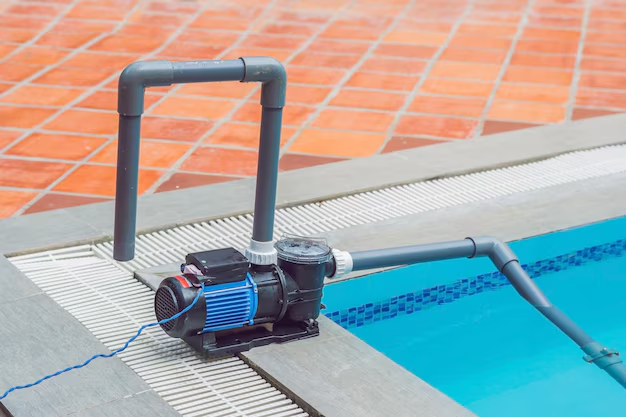
What Are the Best Swimming Pool Pumps? A Simple Guide (with Kolkata tips)
Choosing the “best” swimming pool pump is not about chasing the biggest horsepower or the shiniest brand badge. The best pump is the one that keeps your water sparkling, uses the least electricity for the job, runs quietly, and lasts for years with minimal fuss. In this guide, I’ll break that down in clear, simple English—no engineering degree needed. I’ll also add some Kolkata-specific pointers and explain how a good supplier makes all the difference.
First things first: what does a pool pump actually do?
Your pump is the heart of the pool. It pulls water from the skimmer and drain, pushes it through the filter (and heater, chlorinator, or salt system if you have them), and returns clean water back to the pool. If the pump is wrong for your pool—too big, too small, or just inefficient—you’ll fight cloudy water, high power bills, and frequent breakdowns. In short, your pump sets the tone for how easy—and how costly—your pool will be to own.
What makes a pool pump “the best”?
Think of “best” as a checklist:
-
Right size and the right flow
A great pump moves enough water to “turn over” your whole pool within a reasonable time, without wasting energy. Industry sources commonly size filtration flow around 6 hours for turnover (especially for design/maximum filtration flow), while installers may tune day-to-day speeds so that a 12-hour turnover still keeps water healthy—especially when using efficient variable-speed pumps.
-
Matched to your plumbing (TDH)
Total Dynamic Head (TDH) is a simple idea: it’s the overall resistance your plumbing system creates—pipes, elbows, valves, filter, heater, everything. The best pump is chosen against your TDH, not just horsepower. That’s how you get the right flow at the right energy use.
-
Energy efficiency
Variable-speed pumps (VSPs) can slow down for everyday filtration and ramp up for vacuuming or water features. That simple ability to run slower most of the time is why ENERGY STAR notes pool pumps can use up to 70% less energy than standard pumps. Manufacturers sometimes claim even higher savings for specific premium models.
-
Quiet operation
The best pumps don’t howl. Many modern VSPs use permanent-magnet motors and improved hydraulics that cut noise dramatically—some are marketed as library-quiet (e.g., Pentair’s IntelliFlo line is promoted “as low as 45 dB”). Quiet pumps matter near walls, balconies, and neighbors.
-
Built to last
Look for corrosion-resistant wet ends, quality mechanical seals (Viton® or equivalent), and robust baskets and lids. Self-priming designs are a plus for most in-ground pools (they can lift water from below pump level); some models advertise priming up to 2.5 m.
-
Easy to live with
A large, easy-to-open strainer basket saves time. A clear lid helps you see debris. Simple, lockable controls avoid accidental changes. Unions on the ports make service simpler.
-
Smart compatibility
If you plan automation (light scenes, heaters, water features), check that the pump talks smoothly with your controller—either brand-native or via open relays/RS-485.
-
Backed locally
A great pump with poor local support becomes a headache. The “best” includes reliable Kolkata-area after-sales service, warranty handling, and spare parts availability.
Sizing made simple (and safe)
You’ll see many online calculators, but here’s the plain-English approach any good technician or supplier should follow:
Step 1: Know your turnover.
Turnover means how long it takes to circulate a volume of water equal to your pool’s volume. For filtration design, a 6-hour turnover is a common standard reference in industry documents; for everyday operation, many pros set variable-speed pumps so the pool turns over in about 8–12 hours to save energy while maintaining clarity. Both the 6-hour design reference and the 12-hour “minimum acceptable” concept appear in respected industry/energy guidance.
Step 2: Estimate your TDH.
TDH is your system’s resistance to flow. Long runs of pipe, lots of elbows, small-diameter lines, elevated equipment, and “tight” filters raise TDH. The pump you pick must hit your target flow at your TDH when you read the manufacturer’s pump curve. If that sentence feels technical, don’t worry—that’s exactly where a competent supplier earns their keep. (There are professional TDH calculators and step-by-step gauge methods many technicians use in the field.)
Why not just pick by horsepower?
Horsepower is only part of the story. Two pumps with the same HP can move very different amounts of water at the same TDH. Picking by HP alone can leave you with a loud, power-hungry pump that still doesn’t circulate properly.
Single-speed vs. two-speed vs. variable-speed
-
Single-speed pumps run at one fixed speed. They’re simple but usually the least efficient and often the noisiest.
-
Two-speed pumps let you run a slower “filtration” speed most of the time and a higher speed for tasks that need it. This already cuts energy use compared to single-speed.
-
Variable-speed (VSP) pumps let you set the exact RPM for each task—skimming, filtration, vacuuming, waterfalls, even solar heating. Because pump power draw drops steeply when you slow the RPM, VSPs can slash electricity use. ENERGY STAR’s consumer guidance cites up to ~70% less energy than standard pumps, and leading manufacturers (e.g., Hayward’s TriStar VS series) market “up to 90%” energy cost savings vs. single-speed on some models. Real-world savings will depend on your pool size, run hours, and energy tariff, but the direction is clear: VSPs are today’s efficiency champions.
Tip for Kolkata homes: Power costs and monsoon debris loads vary by neighborhood. A VSP lets you schedule lower overnight speeds for quiet, cheap filtration, then auto-boost during daylight skimming when leaves and dust are worst.
Reading efficiency labels: what is WEF?
If you see WEF (Weighted Energy Factor) on a spec sheet, that’s a standard efficiency metric used widely in the U.S. It measures how much water a pump moves per unit of electricity across different loads. Higher WEF = better efficiency. It helps compare models on a level playing field. You don’t need to memorize the equation; just know it’s a standardized way to judge efficiency across brands and speeds.
How quiet is “quiet”?
Noise is more than comfort—it’s neighbor relations. Many VSPs use permanent-magnet, totally enclosed motors with better cooling and smoother operation. Some flagship models are promoted as extremely quiet—as low as ~45 dB—which is in the ballpark of soft conversation. In backyards where the pump sits near a bedroom or boundary wall, that difference is huge.
Build quality details that matter
-
Self-priming design for in-ground pools makes startup easy and reliable; several well-known pumps advertise priming heights in the 2–2.5 m range.
-
Mechanical seal quality (e.g., Viton®) resists chemical attack.
-
Large strainer basket & clear lid reduce cleaning time.
-
Union fittings simplify service.
-
Corrosion-resistant housings (UV-stabilized composites, quality fasteners) last longer in Indian sun and moisture.
Brands and examples (to orient yourself)
You’ll find many solid brands on the Indian market, including Pentair, Hayward, AstralPool (Fluidra), Emaux, and others. Each has multiple lines: entry, mid, and premium variable-speed. The exact “best” model depends on your pool’s size and TDH, but looking at top-tier VSP families is a safe starting point.
-
Hayward TriStar VS series: Marketed as ultra-high efficiency, with claims of up to 90% energy cost savings compared to single-speed. Known for strong hydraulics and durable seals. Hayward
-
Pentair IntelliFlo family: Well-known for very quiet operation and flexible programming; often promoted as “as low as 45 dB” and a benchmark line in the category.
-
AstralPool (Fluidra) and Emaux: Widely distributed in India/Asia; Emaux literature highlights self-priming designs and corrosion-resistant materials, while AstralPool offers a broad portfolio of pumps tailored for different pool sizes and features.
How a good supplier helps you get the best pump (this part really matters)
A supplier isn’t just a shop. The best suppliers behave like partners who protect your money and your time. Here’s what a professional swimming pool pump supplier should do:
-
Site visit and questionnaire
They review your pool size and shape, measure approximate pipe runs, look at the equipment pad layout, check valve counts/elbows, and note vertical lift to estimate TDH. They also ask about how you use the pool—party weekends? water features? future heater?—because those affect the speed profiles they’ll program later.
-
Right-sized recommendation
They calculate the flow needed for a sensible turnover (often designed around a 6-hour reference and operated at slower speeds for energy savings) and match a pump curve to your TDH. You get a clear, written rationale rather than just “This is 2 HP, so it’s powerful.” -
Clear cost-of-ownership math
Instead of only quoting the purchase price, they estimate power cost at typical speeds and hours so you can compare single-speed vs. variable-speed honestly. They’ll show you how low-RPM filtration wins on energy because power draw falls much faster than flow when you reduce RPM—hence the big savings numbers you see in ENERGY STAR materials and brand brochures. -
Clean installation
Good installers use unions, vibration pads, proper earthing, straight pipe runs into the suction side, and correct pump elevation to make priming easy. They also minimize bends and unnecessary valves that add TDH (resistance). -
Smart programming
They create simple schedules: low overnight filtration, daytime skim boost, weekly higher-speed purge, and dedicated speeds for vacuuming or backwashing. If you have a salt chlorinator or heat pump/solar, they’ll coordinate flows so everything plays nicely. -
After-sales and spares
They stock lids, baskets, seals, and capacitors; they know warranty routes; and they answer the phone during monsoon season when leaves and dust spike and you need advice quickly.
Why Kolkata needs this level of care:
Local power quality, humidity, and monsoon debris can be tough on equipment. A supplier who understands these realities will steer you toward pumps with sealed electronics, stronger seals, and practical schedules that keep water clear without running up your CESC bill.
Common mistakes to avoid
-
Buying by horsepower alone (it’s not a reliable sizing method).
-
Ignoring TDH and the pump curve—this leads to noisy, inefficient setups.
-
Skipping variable-speed when you run the pump for long hours—it often pays itself back through electricity savings.
-
Poor plumbing on install (tight elbows into suction, no unions, long tortuous runs).
-
No debris plan in monsoon—schedule higher RPM skims on dusty or leafy days.
A 60-second shortlist: how to pick your best pump
-
Get your pool volume and a target turnover window you feel good about (design for ~6 hours, operate ~8–12 hours for efficiency).
-
Choose a variable-speed model that hits your target flow at your TDH, then compare WEF ratings and noise claims across a couple of reputable brands.
-
Confirm local service and spares before you buy.
Searching for a "swimming pool pump supplier in Kolkata”?
If you typed that exact phrase online (typo and all), what you really want is a local partner who doesn’t just sell a box—but sizes, installs, programs, and supports the pump so you get clear water at the lowest sensible cost. The “best” pump isn’t just the model number; it’s the match to your pool and the care that goes into setup.
Final word: our pick for Kolkata
If you want a dependable swimming pool pump supplier in Kolkata who will calculate your flow correctly, match the pump to your TDH, program efficient schedules, and stand by you during peak season, Dazzling Pool is an outstanding choice. They focus on practical sizing, clean installs, and real-world energy savings—exactly what separates a “good” pump from the best pump in day-to-day use.